
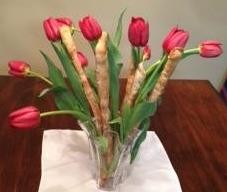
Some are tall, thin and graceful; others possess an awkward beauty with charming imperfections. Their allure is undeniable, their appeal universal to those who know them. People like my father are drawn to their big crunch, mild flavor, and towering elegance. Sometimes relegated to tight neat, uniform bundles, their varying heights and widths and crooked bodies also mean they could be bunched askew in some wild bouquet.
They grace the tables of Italian restaurants from coast to coast – and yes, I’m talking about grissini. That’s breadsticks in English. And they are certainly more than just a stick of bread. I’m not talking about the soft, squat, squishy versions. I mean the hard, tall, thin, crunchy originals developed in 17th century northern Italy.
My father has been an ardent fan of the breadstick for a while, taking joy in the Cookie-Monsteresque chomp-fest replete with crumbs flying in all directions. Sometimes he likes to punctuate sentences with a brief wave of a grissino; other times he just likes to munch in silence, focusing on the whole experience, from flavor, to crispy crunch, to sound. He remembers eating them frequently when growing up; his mother would buy them at an Italian bakery or the corner grocery store (where the sticks still came from that Italian bakery) in San Francisco’s Marina district, with its highly concentrated Italian immigrant population. The grissini were never the star of the meal, but they were an important player on the table several nights a week.
After visits with his sister years later, she would routinely send my father off with a tall, awkwardly beautiful bundle from Lucca Deli. And now friends and family supply him with his breadstick fix when they can.
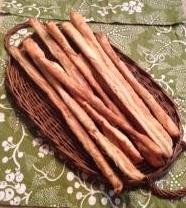
Turns out my father is not only in good company in his love of grissini, but that they have a royal history as well. One story has it that they were created in the late 17th century in the northern Italian city of Torino by the court baker Antonio Brunero as a remedy for future King Vittorio Amedeo of Savoy’s digestive problems. Unable to digest even breadcrumbs without “issues,” the thin and crunchy sticks of bread went down without a hitch. Grissini became quite popular throughout Italy due to their high digestibility compared to regular bread. It also helped that they would stay fresh for weeks.
Perhaps more remarkable is that grissini were also the Sticks That Launched a Thousand Stagecoach Trips: apparently Napoleon had his own obsession for breadsticks — so much so that he founded a stagecoach service in the 19th century between Torino and Paris primarily devoted to the delivery of his beloved grissini!
![1810Napoleon[41]](https://kgioia.com/wp-content/uploads/2014/06/1810napoleon41.jpg)
(Wait – is that a grissino in his hand?)
What a contradiction in form and flavor: that dramatic baton, long and thin, sometimes jagged and bumpy, both elegant and rugged at once, with a massive crunch to be heard rooms away. Yet what a mild flavor (those original plain ones, at least) belies their imposing figure. Now cooks routinely jazz them up with seeds, herbs, cheeses, or wrap them in prosciutto. They seem to have ascended in rank as a necessity on the Italian antipasti platter.
But for my father, plain is always best. I whipped up some simple grissini the other day using a version of Carol Field’s recipe for Grissini Torinesi (below) and then relayed the sticks to my father during our recent visit a few days later. They were just as tasty — and even better, according to him — with their more substantial crunch brought on by age. Definitely Napoleon-worthy in his book.
Recipe based on Grissini Torinesi from Carol Field’s book The Italian Baker
INGREDIENTS:
1 3/4 teaspoons active dry yeast
1 tablespoon malt syrup (if you don’t have any, the breadsticks come out fine)
1 1/4 cups warm water
2 tablespoons olive oil + more for brushing the dough
3 3/4 cups unbleached all-purpose flour
1 1/2 teaspoons kosher salt + more for sprinkling
1/2 cup semolina flour for sprinkling
INSTRUCTIONS:
Stir yeast and malt into warm water in the bowl of a stand mixer (may be done by hand too — read on!). Let stand until foamy, about 10 minutes. Mix in 2 tablespoons oil with paddle attachment. Add flour and salt and mix until dough comes together. Change to dough hook and knead at low speed about 3 minutes. Finish kneading briefly by hand on a lightly floured surface. N.B.: you can mix dough by hand and knead by hand until dough is smooth, soft, velvety and elastic, 8 to 10 minutes.
Pat the dough with your hands into a 14- x 4-inch rectangle on a well-floured surface. Lightly brush top with oil. Cover with plastic wrap and let rise until doubled, about 1 hour.
Sprinkle dough with semolina flour before cutting and stretching (although it’s not a big problem if you don’t have semolina flour…). Cut dough crosswise into 4 equal sections, then cut each section into 8 strips about the width of a finger. The dough is so elastic that you can simply pick up each piece and stretch it between your hands to fit the length of a baking sheet. Place the breadsticks on lightly oiled baking sheets or on a sheet of parchment paper.
Preheat the oven to 400°. Just before baking, spray the breadsticks lightly with water. Sprinkle with kosher salt if desired. Bake the breadsticks until light brown and crisp, 20 to 25 minutes.
 kgioia